
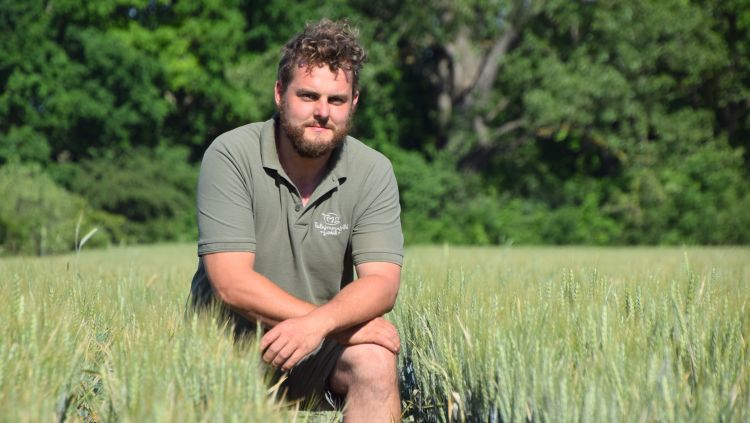
Bence's farm isn't plowed, yet the yields are good on the sandy soil
They're constantly thinking things through, yet they don't complain about the drought—instead, they rise to the challenge
These days, the tone of the domestic crop production sector is one of uncertainty: soil quality is deteriorating, the weather is wildly unpredictable, and markets are weak. It’s refreshing to talk to farmers who aren’t daunted by these challenges: The Ritzl Family His family farm, located on fields with particularly poor soil conditions, has produced respectable yields and income even with very little rain—„even though” they haven't tilled the soil for about a decade and a half. What’s the secret?—to find the answer, we traveled to Baja, where we also learned why an acacia tree had grown right into the plow…
(Photo: Zoltán Kohout/Horizont Media)
Together with his father, Bence continues to run the family farm in the Baja micro-region, which was founded by his great-grandmother and launched by his father. Today, the family farms approximately 150 hectares within a radius of a few kilometers. The characteristics of the fields vary greatly: there are floodplains along the Danube, sandy areas with shallow topsoil, as well as sandy soils with better structure and higher humus content. This diversity alone has taught them to be cautious, since what works on one field can easily pose a risk on another.
See also this article of ours:
It is no longer up to regenerative agriculture to prove itself
Plowing has been phased out of the system for more than ten years
Crop production has now become the main focus of the farm. The crop rotation includes cereals, fall and spring oats, wheat, seed production, peas, sunflowers, and, on a smaller scale, corn, among others. However, the central element of their farming technology is not any single crop, but rather the preservation of soil health. In the Bencés’ view, the soil is not merely a growing medium, but a resource whose water-holding capacity, structure, and biological activity are decisive factors in determining the farm’s future.
According to Bence, the change didn’t happen overnight. At first, they were just experimenting: they loosened the soil in one area, disc-harrowed another, and cultivated more shallowly in yet another. They monitored whether there was a significant difference in yield and how much time, fuel, and energy each method required. Based on several years of experience, they concluded that less tillage does not necessarily mean poorer results.
As he said, the last time they plowed was in 2013. Years later, the plow was removed from the farm with an acacia tree practically grown right into it (!). This clearly illustrates how definitive the shift has become: the plow-based cultivation system was gradually replaced first by no-till farming, and then by direct seeding. According to Bence, the decisive realization during the transition was that disturbing the soil not only means work but also loss—in soil structure, moisture, and time alike.
For them, direct seeding isn't just a trend—it's a water conservation strategy
The farm now uses a no-till system, which means the seeder does the work without any preceding plowing, disc harrowing, or loosening. Bence put it this way: any soil tillage results in water loss. Plowing, loosening, disc harrowing, or even tilling can remove moisture from the soil in amounts measurable in millimeters.
Given today’s extreme weather conditions, this is no longer a minor issue. If a farm loses 5, 10, or even more millimeters of water due to unnecessary tillage, that water may be lacking later on during germination, tillering, or grain formation. That’s why the Bencés aren’t thinking about irrigation; instead, they’re focusing on using technology that keeps as much water as possible in the soil. For them, direct seeding is not a technological oddity, but a response to the fact that rainfall is becoming increasingly unpredictable and summers are putting greater and greater strain on the soil.
Stubble is not an obstacle, but a cover
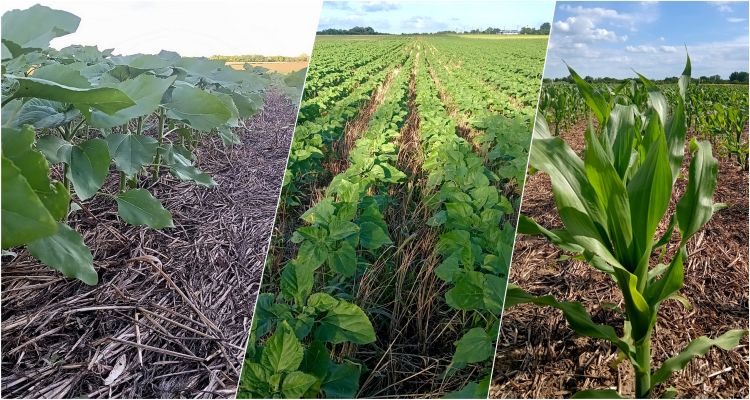
A key aspect of the system is that the goal is not to remove crop residues but to leave them on the surface. Plant residues left on the field shade the soil, reduce evaporation, protect the surface from erosion, and help maintain soil life.
According to Bence, this is particularly important in sandier areas with poorer water management. Where the sun shines directly on the soil for longer periods, moisture is lost more quickly. A covered surface, on the other hand, helps ensure that previous rainfall continues to be utilized. The farm has also observed that, on certain stubble fields, grains were able to germinate even during a very dry fall because enough moisture remained in the soil to support germination. In practice, this means that crop residue is not waste, but rather one of the guarantees for the successful establishment of the next crop. „There is much to learn about this in practice, because crop residue raises issues related to seeding and plant protection. However, it also provides many answers to problems that arise in conventional farming. Just one example: on one field where the harvest was done with tall stubble, the depth of the saturated layer after a heavy rain was 18–20 centimeters; on a field with shorter stubble, it was only 10 centimeters. ”It also makes a big difference how much plant residue traps the wind and how much water it can help infiltrate into the soil,” notes the young specialist, who completed his agricultural studies in Hódmezővásárhely, offering a vivid lesson.
Cover crops were planted on 60 hectares in preparation for the spring crops
Cover crops are not treated as an administrative requirement. Bence emphasized that they do not want to simply „check off” greening as a task, but rather to give it meaning. Last year, they planted cover crops on about 60 hectares, which were intended to precede the spring crops. These crops sprouted nicely in the fall, remained in the field throughout the winter, and were then harvested in the spring.
For them, cover crops serve multiple purposes: they protect the soil, cover the surface, improve soil structure with their roots, and nourish soil life with sugars. The next main crop is thus not planted in „bare” soil, but in a medium where living root channels, organic residues, and more active biological processes already await it. According to Bence, a cover crop remains beneficial even if a significant portion of it is grazed by wildlife, because the root system and the biological impact left in the soil do not disappear in such cases.
It matters which main crop is planted after which preceding crop
Cover crop mixtures are always tailored to the next main crop. According to Bence, an important rule is to avoid including related plants in the mixture if the subsequent main crop is the same or closely related. Sunflowers, for example, can be a good, inexpensive, frost-sensitive, and strong taproot component in a mixture, but if the next main crop is also sunflowers, they are not included.
There is also a plant protection reason for this: it is not advisable to intentionally maintain crop combinations that could facilitate the overwintering of pathogens or pests. That’s why farms think in terms of individual fields. They look at what the previous crop was, what’s coming next, and adjust the seed mix accordingly. Large-seeded peas, for example, may be dispensed from a separate seed hopper, while smaller seeds—oats, canola, sunflowers, flax, and phacelia—are sown from another hopper. This isn’t a spectacular decision, but the stability of the system often depends precisely on such small, well-thought-out steps.
The timing of termination depends on both water and soil temperature
Deciding when to harvest the cover crop is one of the most delicate decisions. According to Bence, in theory, it would be best if the crop remained green for as long as possible, because until then, its living roots continue to nourish the soil. However, if it stays too long, it also consumes water, which the main crop may later lack. „That’s why it’s a constant process of deliberation; constant evaluation is needed. You have to monitor whether rain is expected, how much water is in the soil, when planting is scheduled, and how quickly the soil is warming up. A cover crop left in place too long can keep the surface cooler, which may delay the emergence of certain spring crops. At the same time, early termination can reduce the beneficial effect on soil life,” says Bence. The decision, therefore, is not a one-size-fits-all approach but rather an assessment of the situation; it’s a true test of patience. You have to monitor the weather, the soil, and the needs of the main crop, then make the decision in a timely manner, before the cover crop stops helping and starts drawing water away.
Lower seed rates aren't about saving money—they're about adapting
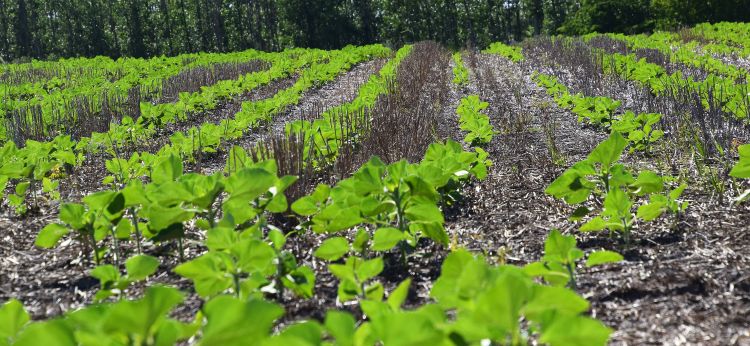
The farm also rethought its seeding rate. With corn, for example, they experimented with a very low seeding rate of approximately 41,500 kernels per plant. By doing so, they accepted from the outset that they would not achieve an exceptional, near-record yield—but that wasn’t the goal anyway. The logic is that in a dry year, there is less competition for water and nutrients among plants in a sparser stand, so each plant has a better chance of producing at least one ear.
Bence is also experimenting with lower seeding rates for cereal crops. In some areas, they plan to sow wheat at a seeding rate of 160–170 kilograms per hectare, while in others, the rate will be 130 or even 100 kilograms per hectare. The question is to what extent the crop can compensate through tillering, and how much less susceptible the sparser crop stand will be to fungal diseases. Thus, sparser seeding is not simply a cost-cutting measure, but rather a deliberate risk management strategy: fewer plants compete for the same water, while a cereal crop that has established itself properly may be able to compensate for the lower plant density through tillering.
The lower standard only applies when soil conditions are good
However, the lower seeding rate does not work on its own. It requires good soil conditions, the right planting time, and rapid germination. If the seed is planted in October but doesn’t germinate until the end of November, then from an agronomic standpoint, it no longer qualifies as an October planting. According to Bence, reducing the seeding rate is a viable option only if the soil can ensure germination and the crop can get off to a timely start.
That is why he does not consider it advisable for someone to try to adopt the system from one year to the next without any preparation. Their move toward less frequent sowing is backed by several years of conservation tillage, improving soil conditions, mulched surfaces, and careful observation. Reducing the seeding rate is therefore not a standalone trick, but rather one consequence of a longer technological journey.
It's not the biggest harvest that counts, but a decent profit
From an economic perspective, record yields are not the main goal. Of course, the yields are still attractive compared to the national averages of recent years. Yields of 6 metric tons per hectare are common for wheat and barley; in 2023, sunflower yields reached 3.9 metric tons per hectare in areas where a neighboring farmer using traditional cultivation methods harvested only 3.4 metric tons. According to Bence, under today’s climate conditions, striving for the old peak yields is often an illusion, especially with corn and in areas with less favorable conditions. „We haven’t been chasing a 120-mazsa corn yield for a long time now: for one thing, it wouldn’t even be possible to achieve that anymore, and for another, it’s not the quantity that matters, but the income-expense balance,” the farmer argues.
Less frequent planting, reduced tillage, and water conservation all serve to help the farm achieve an acceptable yield with lower risk and at a lower cost. This approach does not mean sacrificing yield, but rather protecting profits. If a crop does not set a record but performs consistently with fewer seeds, fewer operations, lower costs, and better water management, it can be more economically valuable than a technology built for high yields but is expensive and risky. For the Bencés, the question is not how much could theoretically be harvested in an ideal year, but rather what technology remains viable across a variety of growing seasons.
It's no coincidence that farmers are worried about the transition
According to Bence, many farmers are afraid of switching to conservation tillage because it really isn’t a simple process. It doesn’t work the way that someone could plow their land to dust one year and then switch to a no-till system the next year without any consequences. The soil needs time, and the farmer needs experience.
Another reason for this apprehension is that conventional farming is more visually striking and familiar. To many people, a freshly tilled, clean field surface still represents good farming, while a field covered with crop residues may seem more disorganized at first glance. In Bence’s experience, however, it is not the „beauty” of the surface that matters, but rather how much water the soil retains, how quickly the plants emerge, and how well the soil structure remains intact. He cites the following as a positive example: Soil Renewal Farmers Association their work: they are the ones who, for years, have been striving to make the knowledge necessary for the transition accessible to farmers by organizing professional communities and holding professional seminars and conferences.
You have to start small, not with the entire farm
Bence recommends that no one start experimenting on a large scale. On a farm of several hundred hectares, a test plot of a few hectares won’t jeopardize operations, but you can learn a great deal from it. In his view, the transition requires patience, observation, an open mind, and connections with farmers who are already further along this path.
Smaller trial plots are also important because every farm is different. Soils, climate risks, machinery, crop rotations, and farming goals all vary. What yields quick results in one place may require a transition period of several years elsewhere. According to Bence, this is precisely why we shouldn’t just copy others, but rather learn, experiment, and tailor the system to our own circumstances.
Regenerative farming is not a formula, but a way of thinking
The example of the Ritzl farm shows that regenerative, no-till farming is not a matter of a single machine or a single technological element. Direct seeding, leaving crop residues in the field, cover crops, the deliberate selection of preceding crops, reduced seed rates, and water conservation together form a system.
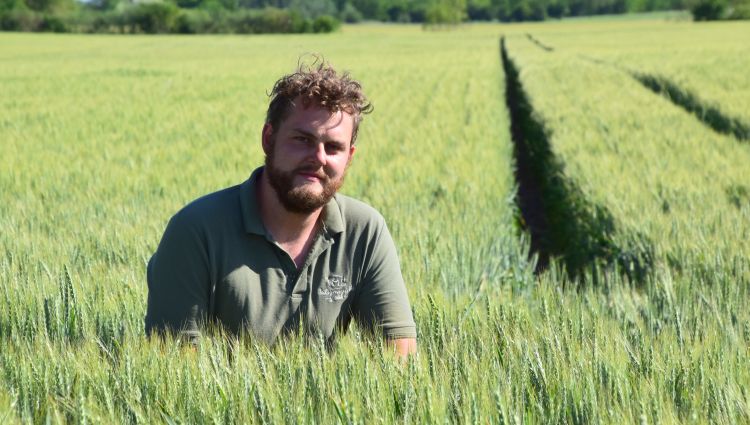
The Bencés aren’t claiming that every farm has to do things this way. Rather, they’re demonstrating that even in areas with less favorable conditions that are prone to drought, it’s possible to move in a direction that relies not on constantly disturbing the soil, but on protecting it. The goal is not to set a spectacular record, but to ensure that the soil, the crops, and the farm remain viable in the long term. „Last year, we had less than 400 millimeters of rain. It’s clear that crop production is possible even with this amount, if we pay close attention,” adds Bence.
Perhaps the most important lesson of this story is that a regenerative approach does not simply mean doing away with certain practices. It is not about simply stopping plowing, tilling, or discing and thinking that’s all there is to the technology. Rather, it means that every decision is weighed in light of the soil’s water reserves, the needs of the next crop, biological processes, and economic outcomes. That is why less intervention can ultimately lead to greater security.
Zoltán Kohout
 English
  Magyar
  Deutsch
  Slovenčina
  Українська
  Polski
  Русский
  Slovenščina