
Gellért's family farm works even better without plowing
The machinery manufacturer and crop grower from Vojvodina has been using regenerative technology for years
Our fellow farmers in Vojvodina who grow crops on arable land are suffering from the consequences of the climate crisis just as much as their colleagues in the Great Plain and southern Hungary; in fact, there, not even EU subsidies mitigate the risks. Gellért Kaszás Under these circumstances, he switched to no-till, regenerative farming, and his account serves as a textbook example of why cover crops, no-till practices, direct seeding, and reduced seed rates.
22 hectares, with a complete shift in mindset
Gellért Kaszás A farmer from Vojvodina farms 22 hectares, where he grows staple field crops: corn, sunflowers, soybeans, barley, wheat, and canola. His farm now operates entirely according to a regenerative approach. As he explained, he first encountered this philosophy in earnest ten or eleven years ago. Previously, he had used plowing, deep tillage, and shallow tillage methods, but after taking over the family lands and beginning to farm them himself, he made the switch.
He didn’t have much experience in agriculture before. He worked in a metalworking shop, operating machinery, and although his family owned land, as a child and teenager he mostly just helped out when needed. However, when he bought his own tractor and began thinking about how to cut costs, he became increasingly interested in soil-regenerating, no-till farming. Inspired by a lecture and online professional forums, he finally decided to give it a try.
From grubbering to full no-till
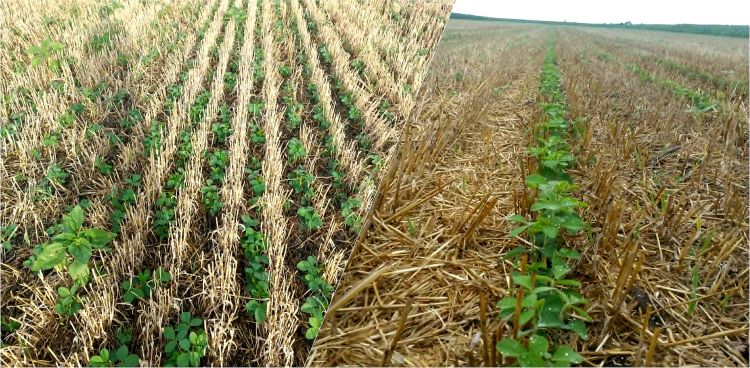
At first, he still tilled the soil to a depth of 10 cm, using only a small Gruber-short-disc combination, but later he stopped doing that as well: he sold the Gruber. Since then—for four years now—he has been working exclusively with no-till technology. This means that he does not plow or till the soil, but instead sows seeds directly into the uncultivated, covered soil. His decision was initially based more on conviction than on personal experience, but since then, his own results have confirmed that he was on the right track.
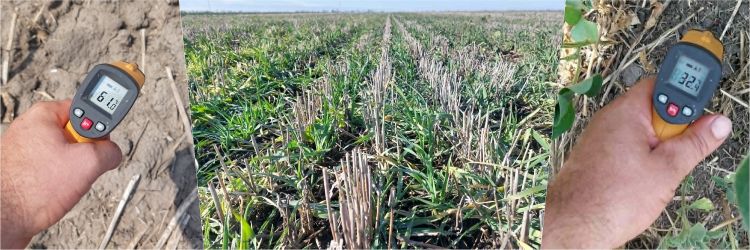
According to Gellért Kaszás, cover crops are one of the keys to regenerative technology. He believes that the natural state of the soil is not an uncovered, bare surface, but rather one that is always covered by some form of vegetation or plant debris. This protects the soil from erosion, overheating, and moisture evaporation. In his experience, there can be a difference of up to 30 °C between the surface temperatures of covered and uncovered soil. Because of the cover, the soil warms up more slowly in the spring, so crops like corn or sunflowers can be planted later; in the summer, however, this same cover helps mitigate heat stress and water loss. „This is no surprise: for millions of years, the soil has „known” how to conserve water and carbon, and how to protect itself from harmful external influences. Regenerative practices essentially mimic natural conditions and mechanisms, which is why they work,” adds the farmer from Vojvodina.
Covered soil protects itself better and retains moisture
According to him, the technology requires a rethink. It’s not enough to simply stop plowing; the entire cultivation system needs to be redesigned. We need to think differently about planting times, crop rotation, cover crop mixtures, nutrient replenishment, and plant protection as well. He put it this way: if someone jumps in unprepared, they may easily encounter surprises, but in such cases, it is not the technology that is at fault, but a lack of knowledge. „I know many people are afraid to get started because they fear their yields will drop, they’ll mess up plant protection, or the technology will be more expensive. My experience, however, is that yes, there is a one- or two-year learning curve during which we might make mistakes here and there. But once past this short period, you can confidently achieve stable yields—and at a lower cost, too. ”Fewer passes, lower seed rates, and fewer inputs are needed, so ultimately, crop production will not only be more stable this way, but also more profitable,” he confirms.
Cover crops, on the other hand, create a more favorable microclimate. Organic matter decomposition remains active longer in the covered soil, and the humus formation, the crumbly structure is more stable, and the mycorrhizal fungi living in the root zone also benefit from a more favorable environment.
Corn reveals the limits of the system
He considers corn to be the most sensitive crop in a no-till system. According to him, this is because corn requires well-aerated, looser soil. In conventional farming, plowing, cultivating, or disc harrowing mixes air into the soil, temporarily creating a looser structure, but at the same time accelerating the oxidation of organic matter. Without tillage, the soil may initially appear more compact until the roots, cover crops, and soil organisms reestablish the natural pore system. Corn can be sensitive to this, especially in drought conditions.
As a result, the role of corn in his farm is declining. Vojvodina is just as arid a region as the eastern and southern parts of Hungary, and according to Gellért Kaszás, corn is becoming less and less of a reliable crop. While barley can consistently produce a good harvest in favorable years, corn is increasingly yielding only modest returns. Sunflowers, on the other hand, are considered a more adaptable crop. Based on his experience, they are easier to grow in a no-till system, tolerate harsher soil conditions better, and have been more profitable than corn in recent years.
Crop Rotation and Sunflowers
He hasn’t experienced any significant additional pest control problems with sunflowers either, even though he doesn’t till the soil. In his view, the key to success is a good crop rotation and the careful selection of cover crops. There are cover crop mixtures in which certain components are harder to eradicate, so it’s important to know exactly what you’re planting and how you’ll manage the crop. The regenerative system, therefore, requires not less knowledge, but a different kind of knowledge.
Soybeans: They're Valuable Even When the Harvest Is Scant
He also grows soybeans, although he believes the region isn’t really an ideal growing area for them. Nevertheless, he keeps them in his crop rotation as a second crop because they are extremely beneficial for the soil. Its strong root system loosens the soil and improves its structure, while its root nodules fix atmospheric nitrogen. For this reason, it is a good preceding crop and can help reduce nitrogen fertilizer costs. Farmers are also experimenting with a method of planting soybeans after early-harvested barley: if the crop looks promising, they harvest it as market soybeans; if not, they leave it in the field as a cover crop.
Fewer seeds, stronger crop
For cereal crops—such as wheat and barley—he considers reducing the seeding rate to be particularly important. In his experience, grain crops are bushy plants, so sowing them densely does not necessarily yield better results. If too many plants are sown in a small area, they weaken each other, and the ears suffer. In contrast, sparser, more deliberate sowing can result in a more stable crop and lower costs.
Regarding rapeseed, he pointed out that many people in his area believe it can only be successfully grown in soil that has been tilled to a very fine, crumbly texture, because it is a small-seeded crop. He, however, has had good results with it even without crop rotation. He doesn’t consider the specific numbers to be important; rather, he focuses on the trend: in his view, rapeseed can also thrive in this system if the farmer understands the logic behind the technology.
Water it…? Better yet, cover it!
Gellért Kaszás believes that irrigation alone is not a solution to drought. In fact, when combined with poor soil management, it can even worsen soil conditions in the long run. According to him, soil that has been tilled many times is like trying to make flour from a crumbly mixture: when water is added, the top layer can become muddy, clog the pores, and form a crust, preventing both air and water from penetrating properly. The coverage and, in his view, preserving soil structure is therefore a more sustainable water management tool than a strategy based on irrigation. According to Gellért Kaszás’s measurements, the surface temperature difference between covered and bare soil can be as much as 30 degrees Celsius—even when they are only a few hundred meters apart! This is important not only for plants but also for the organisms living in the soil microorganisms ...also because of that.
It's not easy to become a scientist or a farmer either
He considers habit and fear to be the biggest obstacles to change. In his experience, many farmers—especially those from multigenerational families who were raised in traditional farming practices—find it difficult to accept that there are other ways to farm successfully. He sometimes senses the same attitude on the part of professional institutions and university faculty: in his view, it is difficult to confront the fact that someone has taught or followed a different approach for decades.
His machinery also helps with conservation tillage
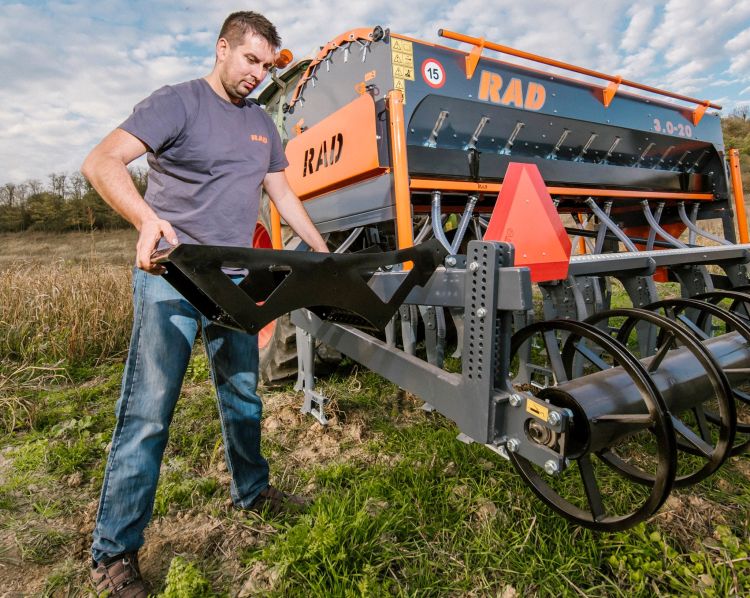
However, Gellért is known not only as a crop farmer but also as a machinery manufacturer among farming communities in Hungary and Vojvodina. He began manufacturing machinery because regenerative farming requires specialized equipment, which is difficult for smaller farms to obtain. No-till seeders from major manufacturers are often 6–9 meters wide and require high horsepower, making them more suitable for large-scale operations. He, however, began manufacturing smaller machines that allow even small farmers to sow directly into unplowed soil.
At first, he only manufactured coulters for retrofitting existing seeders, but later there was a demand for complete machines as well. Today, he manufactures seeders equipped with dual hoppers, allowing both seed and fertilizer to be dispensed simultaneously. Row spacing and seeding depth are adjustable, and the technology helps reduce the number of passes, diesel consumption, and soil compaction. As he explains, sowing a grain crop can thus be completed in a single pass: the seed and nutrients are placed where they need to be, and the plant is ready to grow.
It's not a miracle we need, but insight
According to Gellért Kaszás, regenerative farming is not a miracle cure, but a shift in mindset. It’s not about doing nothing; rather, it’s about working with less disturbance, more observation, and better decisions. He is convinced that keeping the soil covered, avoiding tillage, practicing diverse crop rotations, and using machinery judiciously are viable approaches even for smaller farms.
Zoltán Kohout
 English
  Magyar
  Deutsch
  Slovenčina
  Українська
  Polski
  Русский
  Slovenščina