
Less input, more lives, higher profits
Is yield really the only key measure of an economy's success? The most prominent of the criticisms of regenerative agriculture is the concern about diminishing returns.
However, experience so far shows that the decline in yield levels is far from universal. In many cases, yields remain stable and, in fact, a gradual increase can be achieved by restoring soil life and nutrient cycling. In regenerative systems, the focus is on long-term balance: better water and nutrient management in healthy soils makes plants more resilient to stresses, so yields are less volatile and require fewer external inputs to maintain them.
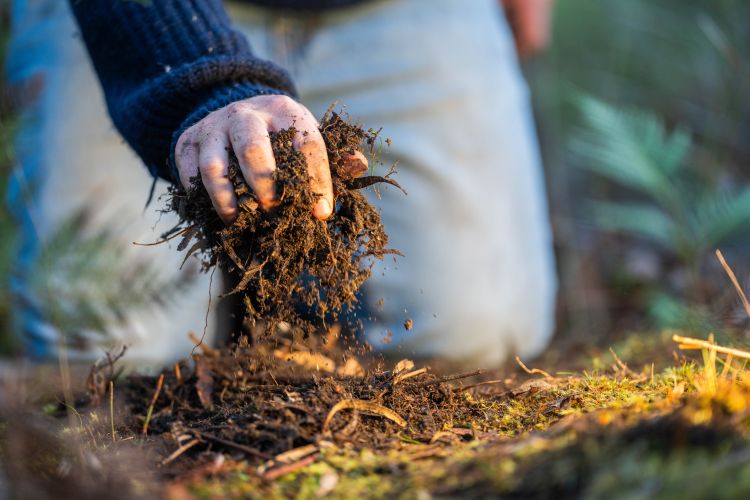
Gradually increase yields by restoring soil life and nutrient cycling
(photos: shutterstock.com)
Profit is not just about increasing yield
Reducing input costs is a common motivation among farmers when considering a move towards regenerative agriculture. Increasing profitability can be achieved not only by increasing yields but also by consciously reducing production costs. In many cases, this is the more sustainable way forward, as inputs and intensive cultivation of arable crops contribute to soil degradation, loss of soil structure and fertility, and thus to the destruction of soil life. In regenerative agriculture, the reduction of inputs is achieved through a holistic, systemic approach that focuses on building healthy, biologically active soils. Such a soil requires less intervention and synthetic inputs, while being more resilient to extreme weather conditions.
The basic principles of regenerative farming include minimising soil disturbance, maintaining a continuous cover of topsoil, maintaining the year-round presence of living roots, increasing biodiversity through cover crops, intercropping and rotation, and integrating livestock production. This shift will allow the farm to benefit from natural processes such as nutrient cycling and natural resistance to pests, thereby improving soil health and resilience, while reducing input costs and increasing environmental and economic benefits. Regenerative conversion will not only result in more life in the soil, but also in more profit for the farmer, with less time and effort. Many farmers report that they have more time for their families since the conversion. More life in the soil - a more balanced, liveable life for the farmer too.
Domestic examples in practice
Attila Szeredi, Csongrád-Csanád county host, a Soil Renewal Farmers Association board member, is constantly innovating its economy because since the regenerative switchover, the demand for live labour has been steadily decreasing. Instead of making redundancies, the farm diversifies its activities and introduces new varieties and new production methods to ensure the continued employment of workers.
Reduced fuel consumption - the first spectacular savings
The first really impressive input cost reductions are in fuel consumption. In regenerative agriculture, fuel consumption is reduced mainly by reducing or eliminating mechanical tillage and by reducing the use of synthetic inputs such as fertilisers and pesticides, which also require significant energy to apply.
Reduced tillage
In conventional farming, the operation of machinery used for deep ploughing and intensive tillage accounts for the majority of fuel use. Among the regenerative practices no-till application yields the greatest savings in fuel oil, as cultivation and seedbed preparation are completely eliminated. In low-tillage systems, even reduced tillage and disc and furrow operations can result in significant fuel savings compared to ploughing. By reducing soil disturbance, farmers can reduce the number of heavy machinery passes for sowing and weeding, which translates into direct fuel savings. Soil compaction and resistance during ploughing increases the energy demand on machinery. In no-till systems, less power is needed, and therefore less fuel.
Less fertiliser, healthier soil
Another tangible result of the regenerative approach is the gradual reduction of agrochemicals, especially fertilisers and pesticides. For most farmers, this is the next big step towards system renewal. However, the basis for this transition is not immediate abandonment but rebuilding soil life and nutrient cycling. Healthy, biologically active soil is able to feed plants and resist stresses on its own, requiring less external intervention. The aim of regenerative farming is not to make quick savings, but to restore the soil to its natural functionality in the long term.
Experience has shown that basic doses of phosphorus and potassium fertilisers can be reduced first, as these nutrients are gradually released through organic matter decomposition and microbial activity. In recent years, however, nitrogen has also become a focus of attention, not only from an economic but also from an environmental point of view. High nitrogen inputs above 180 kg/ha maintain the chemical dependency of plants and hinder the initiation of regenerative processes. Experience shows that nitrogen and pesticide use are closely linked: when nitrogen levels are reduced, plants become more resistant to diseases and fungicide use can be reduced.

Table 1. Costs and characteristics of tillage systems up to sunflower sowing on Attila Szeredi's farm. Estimates include fuel, labour, depreciation and spare parts costs (Kiszombor, 2024)
New directions in nitrogen management
Ferenc Berend, owner of the Somogyi Kószáló Farm, has been on the road to soil regeneration for more than a decade. In the initial period of the transition, he cultivated his crops using soil-friendly methods. Now, for more than six years, these fields have been no-till technology applied. In maize, for example, he achieved an average gross yield of 7 tonnes in 2025 with 60 kg/ha of N, with much higher results in some fields, while in areas affected by wildfire there was a significant loss.
Nitrogen fertilisers at reduced rates, supplemented with a carbon source such as vinasse, humic or fulvic acid, are an effective solution, which are not only more effective but also less stressful for the soil. Balancing the carbon-nitrogen ratio helps maintain microbial activity and increases the utilisation of applied nitrogen in the root zone.

The aim of regenerative farming is to restore the soil to its natural functionality in the long term
Without nitrogen fertilisers
Another option is the complete abandonment of nitrogen-based fertilisers. Zoltán Szabó, a farmer in kiskunmajsa does not apply inorganic nitrogen to the grassland at all, but uses vinasse and a Estence is working with a worm humus-based microbial formulation. He also uses intercropping: he always grows the grasses together with a butterfly plant, such as beech or fodder peas. The butterflies release some of the nitrogen they fix into the soil when they are planted, so that the grasses can use it when they need it most.
International outlook - similar trends in Western Europe
The experience of British and Western European farmers shows that those who follow the regenerative path can gradually (over 3-5 years) reduce fertiliser use by at least 20-401 TP3T, while increasing soil organic matter, stabilising yields and improving farm profitability.

Soil regeneration farmers' experience shows that pesticides are less and less necessary
Declining pesticide use
A similar approach applies to plant protection. In regenerative systems, the gradual withdrawal of insecticides and fungicides does not weaken the ecosystem, but actually strengthens it: biodiversity increases, beneficial organisms return and the natural defence mechanisms of plants are activated. A well-functioning soil life and a balanced nutrient supply will allow the phasing out of chemical interventions in the long term.
In the experience of farmers who are renewing their soil, the need for pesticide control is becoming less frequent - Ferenc Berend, for example, has almost completely abandoned the use of fungicides. At the same time, new challenges are emerging: slug damage is demanding more and more attention. „Profitability should be looked at at the farm level, not at the table level,” stresses Ferenc Berend, who believes that reducing inputs is important not only to maximise prot, but also to enhance the natural functions of the soil, which will make his farm sustainable in the long term.

Healthy, biologically active soil is able to feed plants and resist stresses
Less input, more balance - the way forward
The aim of regenerative agriculture is to phase out the use of harmful and energy-intensive chemicals and to renew soil, ecosystems and farming systems in harmony with nature. Less input does not mean less production, but stabilisation of processes and self-sustainability of systems. Experience shows that soil life the economy will be more balanced, with less external intervention and less use of energy and materials. This will lead to more predictable and sustainable operations in the long term.
AUTHOR: VÍG VITÁLIA • SOIL ECOLOGIST, EDUCATIONAL PROGRAM MANAGER FOR THE ASSOCIATION OF SOIL REGENERATION FARMERS, FOUNDER OF TERRAVITKA
 English
  Magyar
  Deutsch
  Slovenčina
  Українська
  Polski
  Русский
  Slovenščina