
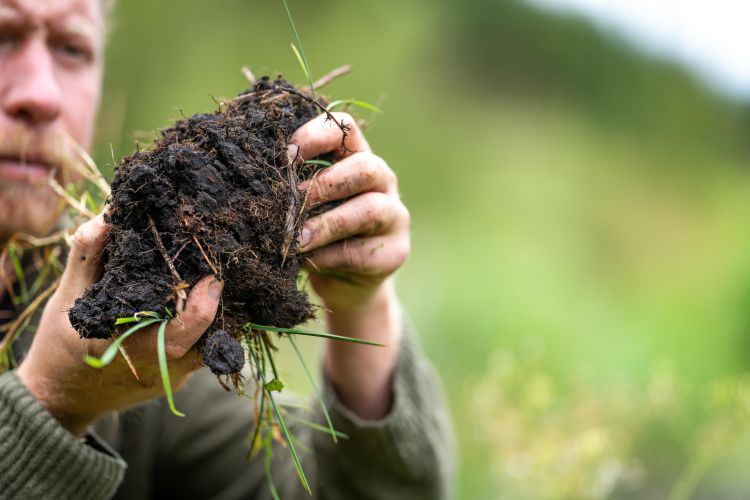
Soil structure
A pile of rubble or a livable space?
Soil structure is one of the most frequently mentioned yet least clearly understood concepts in agriculture. We often discuss it in relation to compaction, tillability, or water management, but we rarely ask the fundamental question: what does soil structure actually mean, and why is it so crucial for fertility?
Simply put, soil structure is nothing more than the spatial arrangement of soil particles—sand, silt, and clay—and organic matter, and the way in which these combine to form stable units known as aggregates. But this definition alone is insufficient. Soil structure is not merely a physical property, but a living environment that determines how water, air, roots, and soil organisms can move, interact, and cooperate within this medium.
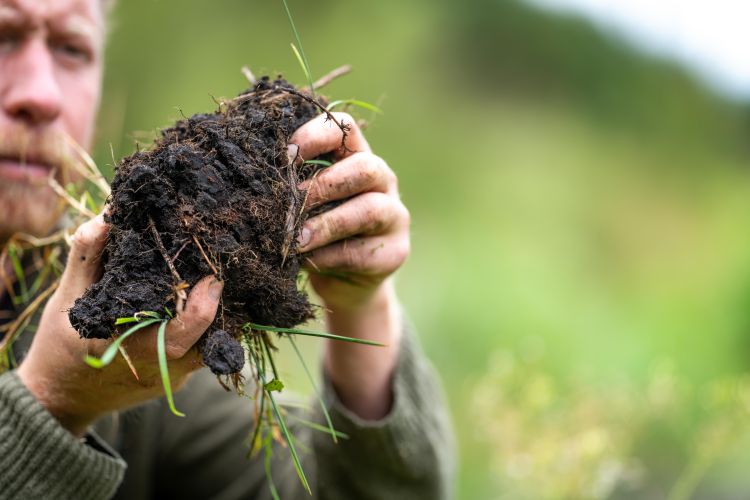
A pile of rubble or a livable house?
According to an old but still highly apt analogy, agricultural soil is often like a pile of broken bricks and debris: the bricks, wood, and nails are all there, but in a disorganized state. In contrast, natural, undisturbed soil is like a built house—or rather, a well-functioning apartment building: with walls, hallways, vents, apartments, and residents.
If we blow up a house and then examine its materials, we can say exactly what percentage of it is brick, concrete, or dust—but we learn nothing about how many rooms it once had, how many people lived there, or whether it was fit for habitation. The same thing happens when we try to interpret soil solely from a physical and chemical perspective, ignoring living organisms. Soil is not merely a collection of materials, but an organized system that can only be understood as a whole.
Who shapes the soil structure?
Soil structure does not form „on its own,” nor is it solely the result of mechanical processes. Structure is the work of living organisms. Soil is a constantly changing, living network shaped by earthworms, insect larvae, mites, springtails, nematodes, protozoa, fungi, and bacteria working together. These organisms create tunnels, bind particles together, produce organic binders, and continuously reorganize the soil’s internal architecture.
Earthworms, for example, not only loosen the soil but also create stable aggregates through their castings. The mucous secretions of bacteria (extracellular polysaccharides) stabilize the finer particles at the microscopic level. They bind the tiny organic particles—measuring just a few hundredths of a millimeter—to the soil’s mineral components. Fungal hyphae—especially mycorrhizal fungi—connect these microaggregates as a physical network while introducing carbon-based adhesives into the system.
From Colloid Chemistry to Biology
For a long time, soil science sought to explain soil structure primarily on the basis of colloidal chemistry and physics. These approaches are important: the surface charge of clay minerals, the role of cations, and the water-air ratio do indeed influence the structure.
But on their own, they do not explain why soil structure breaks down as a result of tillage, or why it improves dramatically where we reduce disturbance and support biological activity.
The key difference lies in how the biological system functions. Living organisms are not passive victims of the soil’s physical condition, but active builders of its structure. Where there is continuous root growth, carbon input, and microbial activity, the soil is able to rebuild its own structure time and again.
The hierarchy of aggregates
Soil structure is not uniform. Aggregates are organized hierarchically. Microaggregates are formed through the interaction of bacteria, fungi, organic colloids, and granular organic matter. These combine to form larger macroaggregates, which are shaped by earthworms, roots, and soil-dwelling arthropods. The more stable this hierarchy is, the better the soil’s water retention capacity, aeration, and load-bearing capacity. A well-structured soil is capable of both absorbing heavy rainfall and withstanding periods of drought.
Life in the soil particles
Soil aggregates are not empty. In fact, they are microhabitats inhabited by bacterial colonies, fungal hyphae, unicellular and multicellular predators, tiny arthropods, larvae, earthworms, and nematodes. These organisms regulate the nutrient cycle and ensure that nutrients are made available to plants. Meanwhile, the crumb structure protects organic carbon from rapid decomposition. If the crumb structure breaks down, this habitat disappears. The soil becomes biologically impoverished, its humus content declines, and the system increasingly relies on external inputs.
How can we examine soil structure?
Soil structure cannot be assessed solely under laboratory conditions. A few simple field tests that anyone can perform can give us an idea of how stable the soil’s crumb structure is and how well it can withstand the destructive effects of water.
Slurry test – testing the stability of the structure
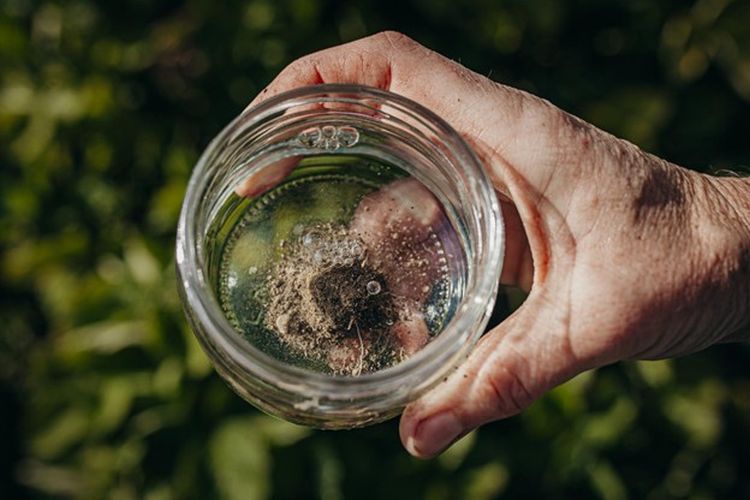
The slurry test (also known as the aggregate stability test) is a simple method for assessing soil condition that can be performed in the field. During the test, we observe how well a clod of soil holds together when submerged in water, which indicates the soil’s structural stability and resistance to erosion.
For this experiment, fill a tall mason jar with water. Cut a piece of mesh bag measuring approximately 20 × 20 centimeters, then secure it to the mouth of the jar with a rubber band so that the mesh hangs about 5 centimeters into the water. Carefully place a clump of dry soil on the mesh so that it is completely covered by the water. Then observe what happens. At the start of the experiment, it is natural for a few small particles to break off and fall into the water. The key question is whether this process stops. If the soil clump remains intact afterward and the water in the jar stays clear, then the soil’s biology is functioning well: the binding agents produced by microorganisms and fungi are capable of holding the soil particles together.
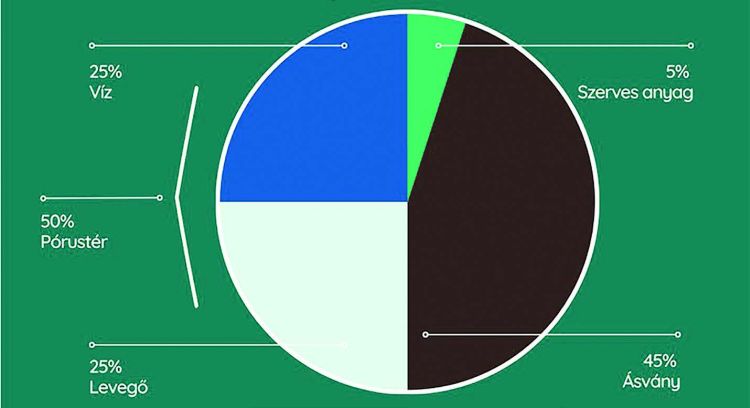
If, on the other hand, the disintegration is continuous—even to the point where the entire clod breaks apart—and the slowly settling clay particles make the water cloudy and discolored, this indicates a weak structure. Such soil compacts easily and is unable to withstand trampling, erosion, or any rainwater that may seep in. its compressive effect. The practical consequence of this is that, after a few rains, the surface of the soil on a well-tilled field becomes crusty and begins to crack.
Jar Test with Soil Crumbs – Testing Water-Stable Aggregates
The soil crumb jar test is a quick and intuitive method for examining water-stable aggregates. To perform this test, use a small jar or glass and fill it with 2–3 centimeters of water. Carefully drop a soil crumb about 1 centimeter in diameter into it. Observe what happens to the crumb for one minute. If it quickly disintegrates in the water, this indicates that the soil structure is inadequate and that the biological network responsible for holding the soil particles together is not functioning.
If the crumb remains intact even after a minute, that’s a good sign in itself. In that case, give the jar a gentle shake. If the crumb still does not fall apart, this indicates that the binding agents produced by the microorganisms that build the soil are resistant to the effects of water, and the soil structure is stable.
These simple tests provide a clear picture of our soil’s structure, whether the soil is more compacted or less so. They show how cultivation decisions made in recent years have affected the soil’s internal organization and whether soil life has been able to counteract the physical stress. The good news is that if we understand the biological functioning of the soil, we can repair the damage to its structure and create well-aerated, water-retaining, erosion-resistant, and capable of supporting natural nutrient cycling within a few years.
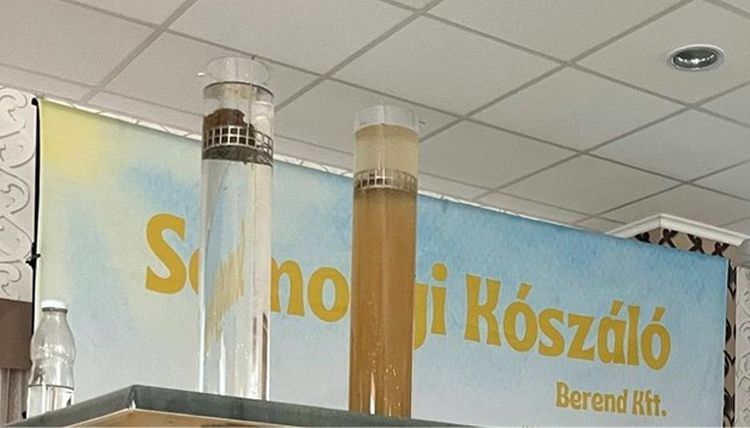
(Photo: Víg Vitália)
What can we do as farmers?
Biological improvement of soil structure is not the result of quick fixes, but rather a well-thought-out, planned, and continuously adaptive process. Organic farming and the regenerative agriculture It does not offer recipes; it is not about piling technological elements on top of one another. In this process, the first and most important step is a shift in mindset. The structure of natural soils is stable not because they are cultivated correctly or rationally, but because the living network that connects, reorganizes, and continuously maintains soil particles has been able to function undisturbed within them over a long period of time.
As farmers, we do not build up the soil structure. This work is done by living organisms, and they alone are capable of doing it. Our role is to create the conditions under which they can carry out this work.
Reducing disturbance
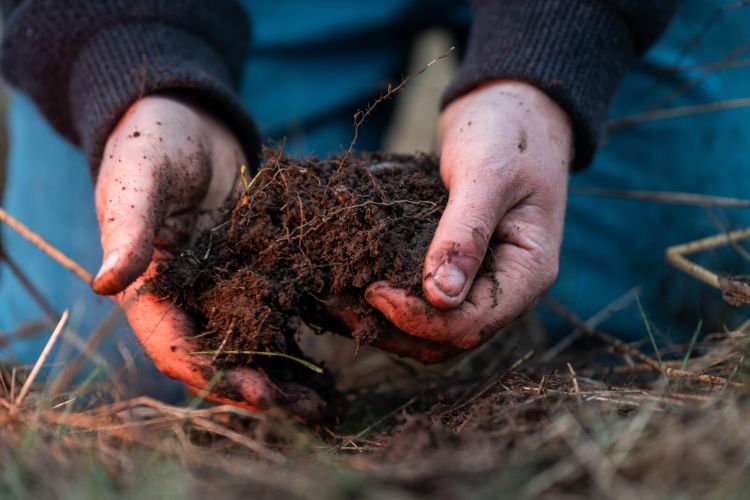
A Soil Tilling is a physical intervention that disrupts the functioning of the biological system. Each tillage operation breaks up the fungal networks, tunnel systems, and microhabitats responsible for the stability of soil aggregates. During cultivation, not only does the soil surface change, but the soil’s internal structure also breaks down, humus is scorched, and living organisms are destroyed.
Reducing tillage—or, in the case of no-till farming, eliminating it entirely—gives the soil time to reorganize itself. It allows living organisms to rebuild the connections without which there can be no stable structure, no water-stable crumb structure, and no resilient soil.
(Photo: Víg Vitália)
In addition to physical disturbance, the use of excessive chemical inputs also has a detrimental effect on soil life and, consequently, on soil structure. The gradual introduction of soil-regenerating agricultural systems allows for a reduction in the use of fertilizers and pesticides, which not only saves money but also restores the soil’s natural functionality. As soil life strengthens, nutrients become increasingly available through biological processes: microorganisms, fungi, and root-microbe interactions regulate nutrient flow. This results in a more balanced supply, with fewer losses, less leaching, and less stress on the plant.
Use of cover crops
The presence of living roots in the soil enables continuous communication with the soil community. The carbon-based compounds in root exudates provide a primary energy source for microorganisms, while acting as a binding agent and directly contributing to the formation of soil aggregates.
A cover crops Their roots penetrate the soil at various depths and in different directions, breaking up and colonizing previously inactive soil volumes. The above-ground biomass of cover crops, just like their roots, provides an important source of organic matter for decomposing organisms. Furthermore, the cover protects the soil surface from the force of rain and sunlight as well as from erosion, which also aids in the undisturbed regeneration of soil structure.
Promoting diversity
The more diverse the life within the soil, the more stable its structure. Different plant species have distinct root architectures, produce different root exudates, and host different microbial communities. It is this diversity that makes the system resilient to extremes.
Monoculture leads to uniformity not only on the surface but also in the soil. As biological diversity declines, the ecosystem becomes more vulnerable. Diversity, on the other hand, provides functional stability: if one element is lost, others are able to take over its role.
The imprint of our decisions lies beneath the surface of the earth
When we drop a pinch of the soil entrusted to our care into that jar filled with water, its structure tells a story. A story about how much life, connection, and cooperation takes place beneath the surface. Although these activities, functions, and relationships are often invisible, they are all the more decisive. We, who work with the earth, write into this story with every decision we make: through cultivation, plant selection, tilling, or even by leaving it alone.
We can choose to treat the land as a pile of rubble and constantly try to patch it up. Or we can choose to nurture a living ecosystem that is capable of sustaining itself, adapting, and renewing itself if we work in harmony with it. The difference is not only measured in crop yield and soil resilience, but also in the kind of farmland we leave behind—and the story that life beneath the surface will tell about us.
AUTHOR: VÍG VITÁLIA • SOIL ECOLOGIST, EDUCATIONAL PROGRAM MANAGER FOR THE ASSOCIATION OF SOIL REGENERATION FARMERS, FOUNDER OF TERRAVITKA
 English
  Magyar
  Deutsch
  Slovenčina
  Українська
  Polski
  Русский
  Slovenščina